Reservoir Modeling & Simulation Services
Understanding subsurface conditions requires engineers to evaluate large amounts of geological, petrophysical, well, and fluid data. Reservoir modeling software provides tools for organizing this information into representations of reservoir conditions that can support technical analysis and project planning.
At IPT Well Solutions, reservoir modeling can be incorporated into broader subsurface evaluations for oil and gas, carbon capture and storage (CCUS), geothermal, solution mining, injection, and other projects. By combining modeling with reservoir engineering expertise, project teams can evaluate subsurface conditions and use simulation results to inform engineering decisions.
How Reservoir Modeling Software Works
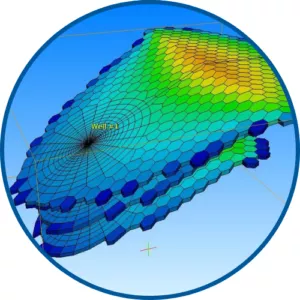
Reservoir models combine available subsurface information to characterize properties such as porosity, permeability, water saturation, reservoir geometry, and fluid characteristics. Engineers can use these inputs to develop static models that represent the geological framework of a reservoir.
Dynamic reservoir simulation builds on this information by evaluating how fluids may behave as reservoir conditions change. Reservoir simulation software can help engineers study pressure response, fluid flow, production behavior, and injection performance over time.
Model quality depends heavily on the underlying data and assumptions. Available field observations can be used to calibrate and validate models, while sensitivity analyses can help engineers understand how uncertainty in individual parameters may affect modeled outcomes.
Using Reservoir Models
Reservoir models can help project teams evaluate potential production or injection scenarios before implementing field activities. Engineers may use simulation to forecast reservoir response, compare development concepts, or examine how changes in well configuration and operating conditions could affect a project.
For complex models, clearly documenting inputs and assumptions is particularly important. Simulation results represent modeled scenarios based on available information rather than guaranteed predictions of future reservoir performance.
Reservoir Modeling for CCUS and Other Applications
Reservoir modeling also plays an important role in carbon capture, utilization, and storage (CCUS) projects. Engineers can evaluate reservoir characteristics associated with CO2 injection and storage, including porosity, permeability, sealing zones, faults, and potential plume behavior.
Similar modeling principles can support geothermal development, solution mining, wastewater disposal and injection, and conventional oil and gas projects. The objectives vary by application, but each requires an understanding of subsurface conditions and potential fluid flow through the reservoir.
Connecting Reservoir Modeling with Engineering
Modeling results can support well planning, completions engineering, injection strategies, and broader project development. For regulated subsurface projects, technical modeling may also contribute to permitting documentation and regulatory review.
Transparent assumptions, model validation, sensitivity analysis, and clear documentation help project teams communicate how conclusions were developed. This approach is especially important when simulation results become part of regulatory, technical, or expert evaluations.
Reservoir Modeling with IPT Well Solutions
IPT Well Solutions brings together reservoir engineering, geoscience, well engineering, completions, permitting, and regulatory expertise for complex subsurface projects.
By incorporating reservoir modeling software and technical interpretation into a multidisciplinary engineering workflow, IPT helps clients evaluate reservoir characteristics and develop technically supported project strategies.