
Webb County Drilling Performance

How Drilling Engineering Services Reduced Well Costs in the Eagle Ford


IPT Well Solutions (IPT) used new procedures and practices to reduce drilling costs in the Eagle Ford. The team applied statistical modeling to evaluate unconventional wells, focusing on lost time incidents, rig types, bit selection, and drilling fluid practices.

The Challenge & Approach

IPT used statistical modeling and lessons learned to drive lower drilling costs in the Eagle Ford.

The team evaluated unconventional well performance by analyzing lost time incidents, rig types, bit selections, drilling fluid types, weighted sweeps, and steerable system performance to identify opportunities for operational improvements and lower drilling costs.

The Solution

IPT leveraged experience from drilling and completing more than 6,000 wells in the United States and over 400 disposal wells to evaluate how to reduce drilling costs in the Eagle Ford unconventional area.

The team reviewed lessons learned analogs, evaluated bit selections, reviewed drilling fluid types and weighted sweep usage, and analyzed different steerable systems.

The Results

IPT reduced drilling costs in Webb County wells by applying better drill bit selection, eliminating weighted sweeps, and using motor steerable (MS) drilling systems.

IPT found that the failure rate of rotary steerable systems (RSS) did not justify the additional costs, even with higher penetration rates. Overall risk-adjusted cycle times improved, despite lower penetration rates, because the lower bottom hole assembly (BHA) failure risk reduced downtime and operational issues.

Lessons learned resulted in using two types of BHAs. The drill-out BHA was designed to drill to kickoff point (KOP) as quickly as possible, while the second BHA was designed to drill the curve and lateral sections.

Motor steerable systems were approximately one day slower in raw drilling speed than RSS systems, but the improved reliability, lower failure rate, elimination of fishing activities, and reduced costs resulted in lower well costs despite slightly longer individual well cycle times. Overall average well times were reduced because of lower lost time incidence.

The net result was overall lower well costs per well and per average.
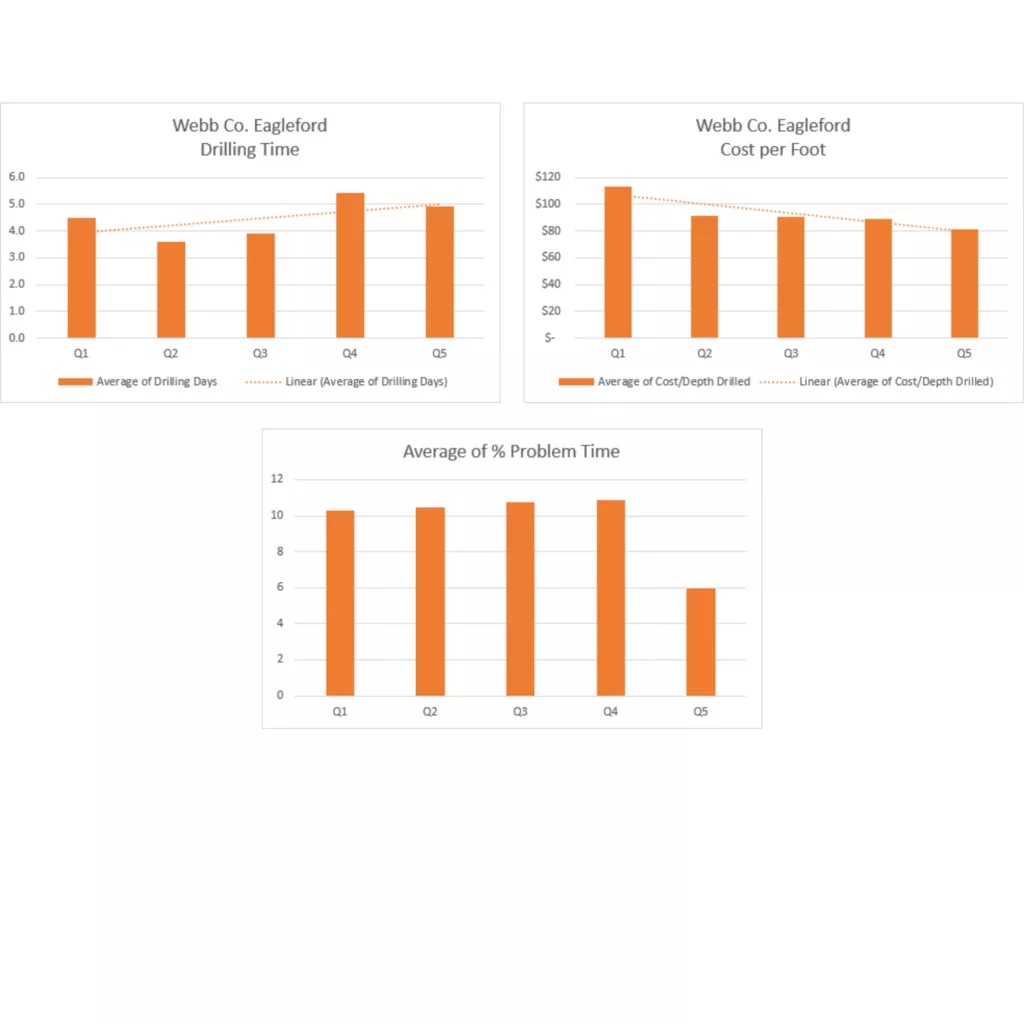
Webb County Drilling Performance Case Study

Drilling engineering services involve the design, optimization, and execution of drilling programs. These services focus on improving efficiency, reducing risk, and lowering costs through technical analysis and field experience.


They reduce costs by optimizing drilling parameters, selecting the right equipment, and minimizing failure risks. This includes improving bit selection, refining drilling fluid systems, and choosing the most reliable steerable technologies.


Motor steerable systems may have lower penetration rates, but they typically offer higher reliability and lower failure rates. This reduces non-productive time and overall well costs.


Drilling performance optimization uses data analysis and operational insights to improve efficiency. It focuses on reducing lost time, improving cycle time, and selecting the most effective drilling methods.


Data is critical. Statistical modeling and lessons learned from previous wells allow operators to make informed decisions that reduce risk and improve outcomes.


Yes. These drilling efficiency improvement strategies are applicable across unconventional plays and other subsurface environments where cost and performance optimization are critical.

If you are looking to reduce drilling costs and improve operational performance, IPT Well Solutions can help.

Our team brings deep technical expertise and field experience to deliver results that impact your bottom line.

Like this article? Share It Using the Links Below:

© Copyright 2022 New IPT Inc. All Rights Reserved.