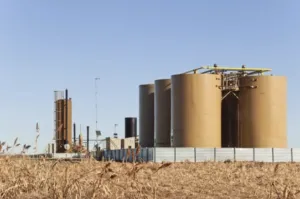
When an operator needs additional saltwater disposal capacity, drilling a new well isn’t always the only option. In some cases, an existing well may be evaluated for conversion to a Class II disposal well.
At first glance, conversion can seem like the simpler choice. The well is already drilled, some infrastructure may already be in place, and existing well records may provide valuable subsurface information. But an available well isn’t automatically a good disposal well candidate.
The right approach depends on the project’s disposal requirements, geology, existing well construction and condition, permitting requirements, necessary modifications, and long-term operating needs.
Before deciding between a new saltwater disposal well and converting an existing well, operators should evaluate several key factors.
1. Start With the Disposal Requirements
Before evaluating a specific well, start with what the disposal project actually needs to accomplish.
Consider:
- Current and anticipated produced-water volumes
- Required disposal capacity
- Expected injection rates
- Source and characteristics of the fluid
- Location of the disposal well relative to producing assets
- Anticipated operating life
- Potential future changes in disposal demand
These requirements provide the baseline for evaluating both options.
An existing well may appear attractive because it is already available, but its location, depth, construction, or injection capacity may not align with the project’s needs. Likewise, a new well requires additional drilling and construction but provides greater flexibility to design the well around the intended disposal service.
The first question, therefore, shouldn’t simply be whether an existing well is available.
It should be whether that well can support the project’s disposal requirements.
2. Evaluate the Target Injection Formation
Whether drilling new or converting an existing well, the proposed injection formation is a critical part of the evaluation.
Depending on available data and project requirements, operators may need to evaluate:
- Formation depth and thickness
- Lithology
- Porosity and permeability
- Formation pressure
- Estimated fracture pressure
- Injection capacity
- Confining formations
- Underground sources of drinking water
- Known or suspected faults and fractures
- Existing offset-well and reservoir data
For a new well, operators may have greater flexibility to select a location and design that targets an appropriate injection interval.
An existing well introduces additional constraints. Its location and depth have already been established, so the question becomes whether an appropriate injection interval is accessible from that particular well and whether the surrounding geology supports the proposed injection operation.
Historical logs, tests, completion records, and nearby well data can help answer these questions, but additional analysis or testing may still be necessary.
3. Review the Existing Well’s Construction and Condition
For a potential conversion, the existing wellbore itself becomes a major part of the evaluation.
Important information may include:
- Casing sizes and setting depths
- Cementing records
- Top of cement
- Existing completion configuration
- Well schematics
- Previously run logs and tests
- Well age and operating history
- Previous workovers or repairs
- Current mechanical condition
- Relationship between the existing well construction and proposed injection interval
Existing well construction records can help determine whether the well may be suitable for conversion and identify areas that require additional investigation.
A conversion is more than assigning a new purpose to an old well. The well must be capable of meeting applicable construction, testing, operating, and mechanical-integrity requirements for injection service.
Incomplete historical records can also affect the evaluation. If casing, cementing, or completion information isn’t adequately documented, additional logging or testing may be necessary to establish the condition of the well.
4. Consider the Area of Review
The well itself isn’t the only potential pathway that must be considered.
Class II permitting includes evaluation of an Area of Review, or AOR, around the proposed injection operation. Wells within the applicable AOR that penetrate the proposed injection zone may need to be identified and evaluated.
Relevant information can include:
- Producing wells
- Existing injection wells
- Abandoned wells
- Dry holes
- Well depths
- Construction and completion records
- Plugging records
The purpose is to identify wellbores or other conditions that could potentially allow injected fluids or pressure to move outside the intended injection zone.
If an existing well is being considered for conversion, the AOR should therefore be part of the feasibility discussion rather than something considered only after the conversion decision has been made.
Potential corrective-action requirements associated with wells in the AOR can affect project scope, schedule, and economics.
5. Determine What Modifications the Existing Well May Need
Even when an existing well has access to a potentially suitable injection formation, it may require modifications before it can operate as a disposal well.
Depending on the well, modifications or additional work could involve:
- Recompletion
- Casing or cement remediation
- Changes to the injection interval
- Tubing and packer installation or modification
- Additional logging and testing
- Mechanical integrity testing
- Surface equipment modifications
- Monitoring equipment
- Wellhead modifications
The extent of this work can significantly affect whether conversion remains attractive compared with drilling a new well.
This is why evaluating only the original drilling cost of the existing well can be misleading. Operators need to consider what it will take to bring the well into suitable condition for its proposed injection service.
6. Compare the Permitting Requirements
Using an existing well does not eliminate the regulatory process.
Saltwater disposal wells are generally regulated as Class II injection wells under the Underground Injection Control program, with permitting administered by either an approved state program or EPA, depending on the jurisdiction.
For a conversion, regulators may require information about the existing well along with the proposed injection operation. This can include:
- Existing well schematics
- Completion and cementing records
- Previously run logs and tests
- Proposed conversion procedures
- Injection-zone information
- Area of Review information
- Proposed injection rates and pressures
- Injection-fluid characteristics
- Monitoring and testing plans
- Mechanical integrity information
The exact requirements vary by jurisdiction and project.
Evaluating the permitting pathway early can help operators understand whether an existing well presents advantages or additional challenges compared with developing a new disposal well.
7. Compare Cost, Schedule, and Long-Term Value
Cost is often one of the first reasons an operator considers conversion, but the comparison isn’t as simple as “existing well equals cheaper.”
An existing well may reduce some drilling and construction costs, particularly if the well is in good condition, appropriately located, and already reaches a suitable injection interval.
However, conversion may also introduce costs associated with:
- Well evaluation
- Logging and testing
- Workovers
- Cement or casing remediation
- Recompletion
- Surface modifications
- Regulatory requirements
- Corrective action within the AOR
A new well requires drilling and construction but provides an opportunity to design the well specifically around the intended injection formation, anticipated disposal volumes, operating conditions, and monitoring requirements.
Schedule can be equally project-specific. An existing well does not automatically mean a faster path to injection if substantial testing, remediation, engineering, or permitting work is required.
Rather than comparing upfront costs alone, operators should consider the expected performance, reliability, operating life, and total project requirements of each option.
New Disposal Well vs. Existing-Well Conversion
There is no universal answer to which approach is better. A useful comparison includes:
Consideration | New Disposal Well | Existing-Well Conversion |
Well design | Can be designed specifically for disposal service | Existing design and condition must be evaluated |
Well location | Greater flexibility in site selection | Location is already established |
Injection target | Greater flexibility to target an appropriate interval | Limited by existing location, depth, and well configuration |
Existing well condition | Not applicable | Major consideration |
Historical data | May rely more heavily on offset and regional information | Existing logs and well records may provide useful data |
Modification requirements | New construction | May require workover, remediation, or recompletion |
Permitting | Required | Required |
Area of Review | Must be evaluated as applicable | Must be evaluated as applicable |
Cost and schedule | Project-specific | Project-specific |
Long-term capacity | Can be designed around anticipated project requirements | Dependent on the existing well and injection formation |
Evaluate the Options Before You Commit
The presence of an existing well can create an opportunity, but availability alone doesn’t determine whether conversion is the right approach.
A meaningful comparison should consider the project’s disposal requirements, injection formation, existing well condition, Area of Review, permitting pathway, required modifications, expected performance, and long-term economics together.
Evaluating these factors early can help operators determine whether an existing well deserves further consideration or whether a purpose-built disposal well better supports the project’s technical and operational requirements.
Considering a New Disposal Well or Existing-Well Conversion?
IPT Well Solutions supports saltwater disposal projects from early feasibility and reservoir evaluation through Class II permitting, well design, construction, testing, and operations.
Whether you’re evaluating an existing well for conversion or considering a new disposal well, IPT can help assess the available technical data, identify information gaps, evaluate disposal options, and develop a path forward for the project.
Contact IPT Well Solutions to discuss your saltwater disposal well project.